What Happened to SmileDirectClub and Byte
Clinically reviewed by Dr. Abinaash Kaur, DDS, RCDSO, on 2026-08-03. Dr. Kaur is a general dentist in Toronto (Bloor West Village) registered with the Royal College of Dental Surgeons of Ontario.
Both companies are gone. SmileDirectClub filed for Chapter 11 protection on September 29, 2023, and the case was converted to a Chapter 7 liquidation on January 26, 2024 (Kroll Restructuring Administration, the court-appointed claims agent). Byte's at-home aligners were pulled from sale on October 24, 2024 and never came back (Dentsply Sirona).
Patients still ask me about this, usually one of two ways. Either they're holding a half-finished set of trays from a company that no longer answers the phone, or they're shopping for treatment now and want to know whether the whole category is a con.
The headlines covered the money. The part almost nobody covered is what the regulators objected to, and it's the only part that changes how you should shop. It wasn't the plastic. It was the missing dentist.
I've practised in Bloor West Village for about 25 years, and I've straightened teeth through most of that. So I'll walk you through what happened, what the research says, and what to do if you're one of the people left holding trays.
What happened to SmileDirectClub?
SmileDirectClub sold clear aligners by mail, with an optional stop at a storefront for a scan. In its last annual report the company said it had "helped over 1,900,000 customers," with SmileShops across the U.S., Puerto Rico, Canada, Australia, the U.K., and Ireland (SmileDirectClub Form 10-K, U.S. Securities and Exchange Commission). Canadians were customers, not spectators.
On September 29, 2023, the company and eight affiliated debtors filed voluntary Chapter 11 petitions in the U.S. Bankruptcy Court for the Southern District of Texas (SmileDirectClub Form 8-K, SEC). Chapter 11 is the version where a business tries to reorganize and survive. That's not what happened. On January 26, 2024 the cases were converted to Chapter 7, which is liquidation, and a trustee was appointed (Kroll).
Most customers paid through a financing plan the company called SmilePay. The typical structure was "$250 up-front payment, followed by 26 monthly installment payments of approximately $89 per month, for a total of more than $2,500" (New York State Attorney General).
Here's the part that stung. After the company stopped operating, its website "continued to misleadingly advise consumers, including those who had not completed their aligner treatment, that they must make any remaining monthly installment payments in full" (New York Attorney General). In December 2024 that office announced it had recovered $4.8 million for more than 28,000 consumers who were charged for services they could no longer receive (New York Attorney General).
There's one more line worth reading, because the company wrote it itself. Its annual report described a "Lifetime Smile Guarantee" and called it "a testament to our confidence in the quality and efficacy of our product" (SEC). A lifetime guarantee lasts exactly as long as the company does.
What happened to Byte?
Byte was the other big mail-order name, owned by the dental manufacturer Dentsply Sirona.
On October 24, 2024, Dentsply Sirona announced "the voluntary suspension of sales and marketing of its Byte Aligners and Impression Kits while the Company conducts a review of certain regulatory requirements related to these products," and said the decision "was made in consultation with the U.S. Food and Drug Administration (FDA)" (Dentsply Sirona). Shipments stopped, including orders already placed.
On January 14, 2025, the company confirmed it was "not reinstating the at-home Byte Aligner Systems and Impression Kits," and said it would refocus the business "around treatments that include expanded in-person dentist oversight" (Dentsply Sirona via GlobeNewswire).
Read that second quote again. The fix the manufacturer landed on was a dentist in the room.
What did the regulators actually object to?
Most people think the problem was cheap plastic. It wasn't. The trays were a cleared medical device.
The FDA logged a Class 2 recall of the Byte Aligner System, recall number Z-0750-2025, initiated by the firm on November 4, 2024 and posted on December 23, 2024, covering 5,324,178 devices (FDA device recall database). The stated reason is one sentence, and it's the sentence this whole post is built around:
"Virtual-only clinical workflow utilized for dental aligners and impression to approve patients for aligner devices may not be suitable for patients who have certain contraindications." (FDA)
Not the aligners. The workflow. The screening step that decides whether you should be wearing them at all.
Dentsply Sirona said the same thing in plainer business language in that October release. Separate from the FDA review, it wrote, "the state regulatory environment has adversely impacted our Byte Aligner business model, resulting in declining conversion rates, and new documentation, records and additional requirements (such as evidence of visits to a dentist or patient x-rays)" (Dentsply Sirona).
So the requirements that hurt the model were proof you'd seen a dentist, and an x-ray. That's a normal Tuesday in my office. It was a business problem for them because the entire saving came from skipping it.
What did it cost the people who were mid-treatment?
Money, first. Then time, and in some cases teeth.
There's also a quieter cost that came out earlier. In June 2023 the District of Columbia's Attorney General announced a settlement releasing more than 17,000 consumers nationwide from nondisclosure agreements they'd signed with SmileDirectClub (Office of the Attorney General for the District of Columbia). Those agreements had blocked people from posting truthful reviews and from reporting problems to regulators (OAG DC).
Think about what that does to the reviews you read before buying. The unhappy customers were contractually quiet.
What does the research say about mail-order aligners?
Two studies are worth your time, and neither one is from a company selling anything.
The first went through the FDA's adverse event database. Researchers pulled reports on sequential aligners from 2010 through 2020 and found 104 that involved direct-to-consumer aligners specifically (Dentistry Journal via PMC). Of those, 90 were classed as injuries, or 86.5% (PMC). The most common problems were bite problems at 41.3%, orofacial pain at 29.8%, and gum and bone consequences at 26.6% (PMC). And 69.2% of those patients followed up with a dentist who had nothing to do with the aligner company (PMC). Somebody local cleaned it up.
The second asked users directly. A 2025 cross-sectional study of 101 people who'd bought mail-order orthodontics found 60% said their expectations weren't met and 64% wouldn't recommend it (Journal of Clinical Medicine via PMC). Among those reporting problems, difficulty biting correctly came up for 48.48%, gum inflammation for 45.45%, and irritation for 42.42% (PMC).
Bite problems and gum inflammation are the two that worry me most. Both are quiet. You don't feel bone loss.
So what does supervision buy you?
Have no fear, this isn't a pitch for making it complicated. It's four specific things.
A diagnosis, before anything moves. Ontario's dental regulator puts it bluntly: "Formulating a diagnosis is the foundation for dental care, there can be no treatment without a diagnosis" (Royal College of Dental Surgeons of Ontario). It describes that process as collecting and analyzing the medical and dental history, a comprehensive clinical examination, and interpretation of radiographic findings (RCDSO).
Records that change the plan. A systematic review in PLoS One looked at which orthodontic records are needed. In one included study, dental models alone gave enough information in only 55% of cases (PLoS One via PMC). In another, adding a cone beam scan changed the treatment plan in 27% of impacted canine cases, and changed the extraction decision in 11% (PMC). A photo of your smile doesn't show a root, a bone level, or a tooth that never came in.
An honest answer about whether aligners suit your case at all. An overview of 18 systematic reviews found clear aligners effective for mild to moderate malocclusion and "associated with inferior outcomes when treating severe cases or with achieving specific tooth movements" (Clinical Oral Investigations via PubMed). A 2025 review is more specific about who should be turned away: "severe malocclusions with impactions or severe craniofacial skeletal deviations are contraindications" (Dentistry via PubMed). If that's your bite, the right answer is braces or a referral, and somebody has to be qualified to say so. Our comparison of Invisalign and braces covers where each one wins, and who Invisalign is genuinely for covers the cases I turn down.
Somebody who's still there at the end. That same overview found "relapse was greater" with aligners than with fixed braces (PubMed). Teeth drift back. Retention is the part of treatment that never finishes, which is why our guide to retainers after Invisalign exists. A retainer plan is worthless if the company issuing the retainers is in liquidation.
One more thing supervision buys you, and it isn't clinical. Gum disease has to be under control before teeth are moved, because pushing teeth through inflamed, infected bone makes the damage worse rather than better. If your gums bleed when you brush, start with our post on bleeding gums and gum disease, not with an impression kit.
You're stranded mid-treatment. What now?
This comes up more than you'd think, and there's a sensible order to it.
Stop wearing a tray that hurts, and keep every tray you have. Don't throw out the set. The last aligner that fit is a rough holding device while you sort out the next step, and the sequence tells me where you were in the plan.
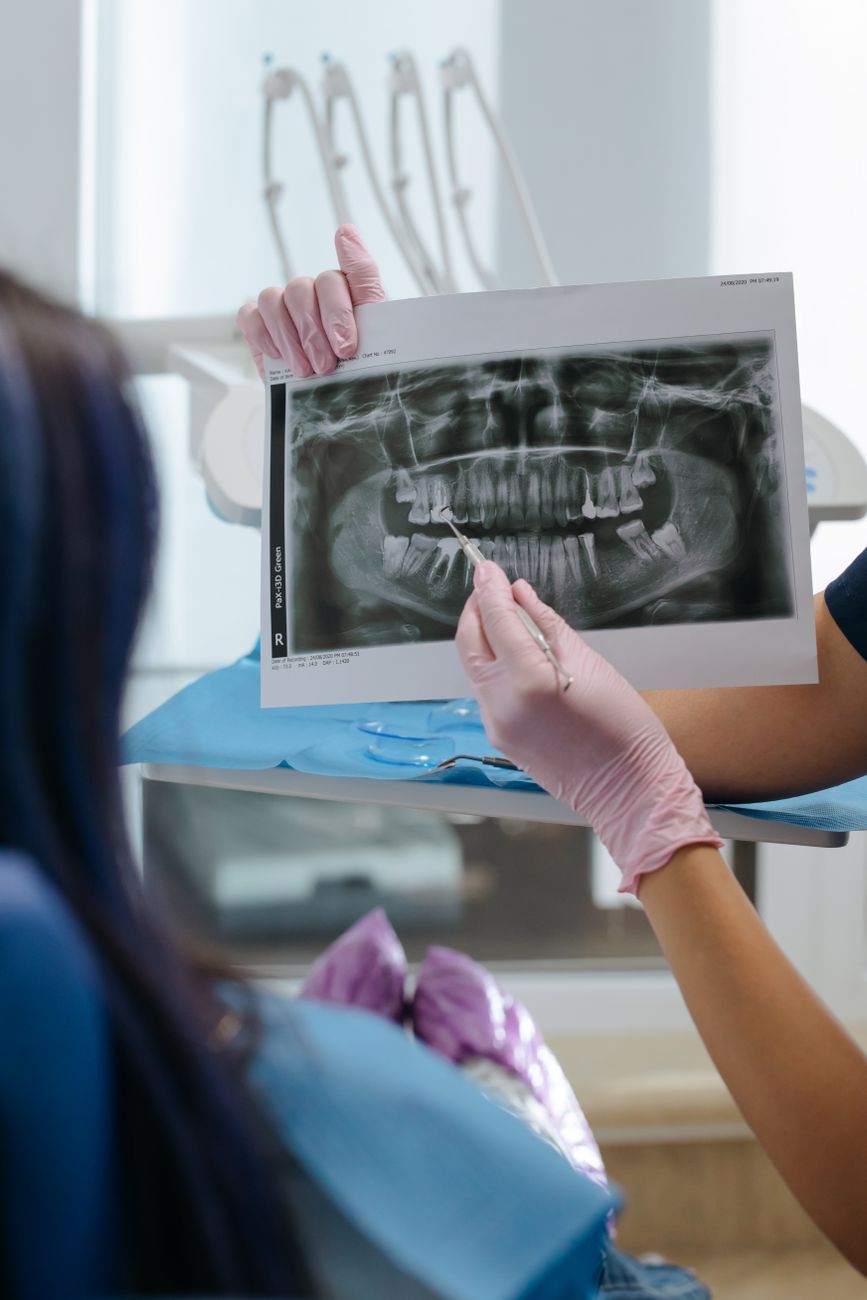
Book an examination, and expect x-rays. I'm not being difficult about this. The x-ray is how we see root position and bone level, which is exactly what the mail-order route never looked at (RCDSO).
Ask what it will take to finish, and get it in writing. Sometimes it's a short finishing course of aligners. Sometimes teeth have already relapsed and it's closer to starting over. Sometimes the honest answer is that your bite was never an aligner case. You're entitled to hear all three options and the cost of each, and you're entitled to a second opinion. Our post on how to tell a real recommendation from an upsell gives you the questions to ask me, or anyone.
Deal with the money separately from the mouth. Payments to a defunct provider are a consumer matter, not a clinical one. Don't let an outstanding balance stop you from getting your teeth looked at.
Don't try to finish it yourself. Every few months somebody tells me about a plan involving elastic bands or a filed edge. Our post on why DIY teeth straightening wrecks smiles has the pictures I'd rather you never generate.
Some days the schedule pushes me hard, and this is still the appointment I don't rush. Somebody who spent $2,500 on a company that vanished is usually embarrassed, and there's nothing to be embarrassed about. The pitch was good and the oversight was thin.
Does this mean clear aligners don't work?
No, and I'd be arguing against my own chair if I said otherwise. I treat with clear aligners every week and the technology is genuinely good for the right bite.
What collapsed was a delivery model, not a device. The trays were fine. The screening was the weak link, and both companies ended up saying so, one through an FDA recall notice and one in a press release promising "expanded in-person dentist oversight" (Dentsply Sirona via GlobeNewswire).
Supervised treatment costs more than a mail-order kit, and I won't pretend otherwise. Our Invisalign cost guide lays out the ranges you'll see across Toronto, and how long treatment usually takes sets expectations on time. What you're paying for is the exam, the x-rays, the judgment about whether to treat you at all, the adjustments along the way, and a practice that's still on the same street next year.
Frequently Asked Questions
Q: Is SmileDirectClub coming back? No. The company filed Chapter 11 on September 29, 2023, and the cases were converted to Chapter 7 liquidation on January 26, 2024, with a trustee appointed (Kroll). Chapter 7 means the business is wound up and its assets sold, not reorganized. Its "Lifetime Smile Guarantee" (SEC) ended with the company.
Q: Do I still have to pay SmilePay if I never finished treatment? That's a consumer-protection question, and at least one regulator has said the company was in the wrong. The New York Attorney General found the company kept telling consumers they had to make remaining installment payments in full after it stopped operating, and announced $4.8 million recovered for more than 28,000 consumers in December 2024 (New York Attorney General). Talk to your bank or card issuer and your provincial consumer protection office. Keep the paperwork.
Q: Why did Byte stop selling aligners? Dentsply Sirona voluntarily suspended sales on October 24, 2024 while reviewing regulatory requirements, in consultation with the FDA (Dentsply Sirona). The FDA recall record gives the reason as a "virtual-only clinical workflow" that "may not be suitable for patients who have certain contraindications" (FDA). In January 2025 the company confirmed the at-home systems weren't coming back (GlobeNewswire).
Q: Can my old aligners be used to finish my treatment? Not usually as they are. Bring them in anyway. The sequence shows where the plan was heading, and the last tray that seated properly can act as a temporary hold while we take records and decide what's realistic. What we can't do is guess at root position from a photo, which is why the examination includes radiographs (RCDSO).
Q: Are mail-order aligners actually dangerous, or is that just dentists complaining? Look at the reports rather than the opinions. In FDA adverse event data on direct-to-consumer aligners from 2010 to 2020, 86.5% of the 104 relevant reports were classed as injuries, with bite problems at 41.3%, orofacial pain at 29.8%, and periodontal consequences at 26.6% (PMC). Nearly seven in ten of those patients ended up seeing an unaffiliated dentist (PMC).
Q: My teeth shifted back after my aligner company closed. Is that normal? It's common, and it isn't your fault. An overview of 18 systematic reviews found relapse was greater with clear aligners than with fixed braces (PubMed). Retention is a long-term commitment, and if nobody's making your retainers anymore, that's the gap. Our retainer guide covers the types and what replacement looks like.
Q: How do I tell whether a clear aligner provider is legitimate? Ask three questions before you pay. Who is the dentist responsible for my care, and can I see them in person? Will you take x-rays and a full examination before treatment starts? What happens to my treatment and my retainers if something goes wrong? A provider who examines you, diagnoses you, and is reachable in your neighbourhood is the difference. There can be no treatment without a diagnosis (RCDSO).
Reviewed by Dr. Abinaash Kaur, B.Sc., DDS (University of Toronto Faculty of Dentistry), who has practised general and family dentistry in Bloor West Village for about 25 years. This article is general oral health information about orthodontic care, not a diagnosis or a substitute for an examination, and it isn't legal or financial advice about a bankruptcy claim.
Holding a box of aligners from a company that's gone? Bring them in and we'll take proper records and tell you honestly what it takes to finish, including whether aligners were ever the right call. We're at 750 Annette Street in Bloor West Village, serving the Junction, High Park, and Baby Point. Book a consultation with The Village Dentist and we'll start with the examination, not the sales pitch.
