Is My Dentist Upselling Me? How to Tell, From a Dentist
Clinically reviewed by Dr. Abinaash Kaur, DDS, RCDSO, on 2026-10-02. Dr. Kaur is a general dentist in Toronto (Bloor West Village) registered with the Royal College of Dental Surgeons of Ontario.
You mostly can't tell from the price. You tell from whether your dentist can show you the problem, whether you were given real alternatives including doing nothing, and whether the plan survives contact with your insurance.
That's the short version, and I'd rather give it to you straight than get defensive. I've been practising in Bloor West Village for about 25 years, we see hundreds of patients a week, and I know the question gets asked in the parking lot instead of the chair. So here's how dental fees work in Ontario, what your dentist is required to tell you, and the specific questions that separate a real recommendation from a sales pitch.
Ask me these questions. Ask the next dentist too.
How do dental fees work in Ontario?
Here's the part almost nobody explains at the front desk.
The Ontario Dental Association publishes an annual Suggested Fee Guide. It lists every dental service a dentist may perform, along with dental codes and suggested fees for each one, and both dentists and dental plan providers use it as a reference point (Ontario Dental Association).
Now the part that surprises people. Dentists aren't required to follow the Guide or any fee schedule. They set their own fees, so a dentist's fees may fall both above and below the Guide (Ontario Dental Association). Two offices a few blocks apart can charge differently for identical work and both be acting properly.
That's not a loophole. It reflects real differences in overhead, materials, lab choices and time. It does mean the guide is a reference, not a price list.
There's a duty attached to it. If a dentist intends to charge fees above the ones listed in the guide, they must tell you (Royal College of Dental Surgeons of Ontario). An estimate should include materials at cost and laboratory fees at cost where they apply, and it can be given as a range of low and high costs (RCDSO).
Since you're reading a post about upselling written by a dentist, you're entitled to know where I stand. We bill to the current ODA Suggested Fee Guide. We don't charge above it, and we don't sell treatment. My job is to tell you what your mouth needs and then help you figure out how to get it done.
The insurance side is worth knowing too. Many dental plan carriers base their coverage on fees and codes within the Guide, sometimes on guides from a year or more back, and the plan providers don't work with the ODA to develop it (Ontario Dental Association). That lag is why your plan sometimes reimburses less than this year's fee even when everyone has done everything right.
Why do two dentists say different things?
Wait, is one of them lying? Usually not. This is the part of the conversation that builds trust, so let me give you the uncomfortable research rather than a reassuring line.
Dentists genuinely disagree about when to intervene. In a study across a large practice-based research network, agreement among dentists on the threshold for treating primary decay ranged from 40% to 68%, and agreement on when to repair or replace an existing filling was only 36% to 43% (Journal of Dental Research).
Read those numbers again. On repairing or replacing a filling, dentists agreed with each other less than half the time.
It shows up when you hand the same case to a room full of clinicians, too. When 27 dental school clinical instructors independently reviewed the same three patient cases, they produced between six and nineteen different treatment plans for each case, and diagnoses for one patient ranged from gingivitis all the way to aggressive periodontitis (Journal of Dental Education).
Those were faculty, teaching in a school, with no financial stake in the answer.
So a second opinion that differs from the first isn't proof anybody's dishonest. Dentistry has real judgment calls in it, especially early decay and aging fillings, which is exactly where "watch it" and "treat it" are both defensible. What you're owed is the reasoning, not certainty.
What is my dentist required to tell me?
More than most people realize, and this is the strongest tool you have.
For your consent to count as informed, the discussion has to cover the nature of the treatment, its expected benefits, its material risks and side effects, alternative treatment options with their own risks and benefits, and the likely consequence of not having treatment at all (RCDSO).
Look at the last two items. Alternatives, and what happens if you do nothing. A treatment plan presented as the only option, with no alternative and no answer to "what if I wait," is missing required pieces of the conversation.
Cost belongs in that discussion as well. The consent conversation is expected to cover the anticipated costs of treatment including lab fees, and the fees agreed to (RCDSO).
One more, for the moment you're already numb and lying back. If a dentist decides the plan needs to change during treatment while you're in the chair, they should explain the additional costs and confirm you agree before carrying on (RCDSO). Finding out about extra work on the way out is not how that's supposed to go.
Which questions reveal the answer?
Try these. The Ontario Dental Association suggests asking why the treatment is being recommended and how it benefits your dental or general health, whether alternative treatment options are available, what the implications are if you refuse or delay, what you can do to prevent similar problems, and what you can do to maintain the work (Ontario Dental Association).
I'd add three of my own, the ones I answer every week.
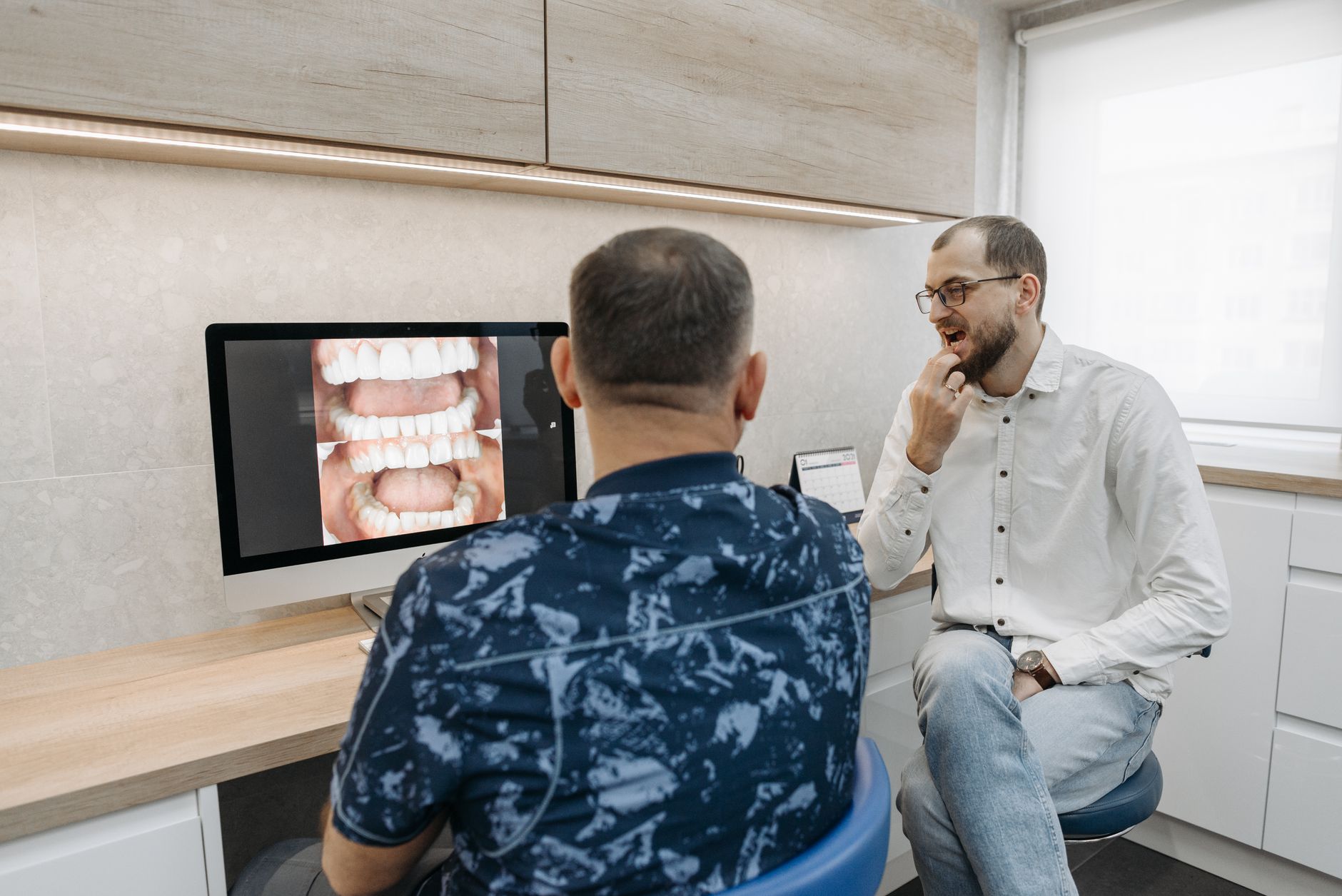
"Can you show me?" This is the big one. A cavity has a shadow on an X-ray. A cracked cusp has a line. Gum disease has pocket numbers and bone levels on a chart. If something needs treatment, it can be pointed at on a screen. Being shown your own films and told what you're looking at should be routine, and our post on telling a real deep-cleaning recommendation from an upsell walks through what that looks like for gums. The same goes for software that marks possible cavities on an image: it can flag a spot, and I've written about what AI cavity detection can and can't tell you, but a dentist should still be able to show you why it's there.
"What happens if I wait six months?" Sometimes the honest answer is "not much, let's re-check it." Sometimes it's "this goes from a filling to a root canal." Both answers are useful. A dentist who can't distinguish between the two isn't triaging, and one who says everything is urgent isn't either.
"Which of these would you do first if you were paying for it yourself?" Any complete plan has an order. Pain and infection first, then things that will get worse and cost more later, then function, then cosmetics. If the plan has no order, ask for one.
You should get plain answers. Your dentist is required to listen and respond to your questions, involve you in decisions about your care, and explain dental information in a way you can understand (RCDSO).
Is "let's watch it" a real plan?
Yes, and it's often the better dentistry. This is where my own bias sits, so I'll name it: I'd rather save your original tooth than replace it with something I made.
The evidence backs the conservative route. Completely removing caries-affected dentine is now considered overtreatment, needlessly invasive and outdated, while selective caries removal arrests the lesion and reduces the risk of exposing the nerve (Journal of Clinical Medicine). Taking out more healthy tooth than you need to weakens the tooth and leaves it likelier to crack later (Journal of Clinical Medicine).
Then there's the cycle nobody warns you about. In a study of 1,337 decisions to replace existing restorations in back teeth, 70% of the recommendations resulted in an increased number of restored surfaces (JADA). Every replacement tends to make the filling bigger.
The FDI World Dental Federation puts the principle plainly: cutting sound tooth tissue always causes irreversible damage, and cavity size invariably increases when restorations are replaced, whatever material is used (International Dental Journal).
A small filling becomes a bigger filling, then a crown, then sometimes a root canal. Each step is reasonable on its own. The whole staircase is worth avoiding when we honestly can, which is why "let's photograph it, chart it, and look again in six months" is a legitimate entry on a treatment plan and not a dentist being lazy. Our post on whether a cavity can heal itself covers where that line sits.
The flip side deserves saying. Watching a tooth is a plan only if somebody is genuinely watching. That means measurements, photos and a date, not a shrug.
Does my insurance decide my treatment?
No, and this is where a lot of the suspicion starts.
If you're unsure how much your plan covers, you can ask your dentist to submit a predetermination request before treatment, and the insurer will tell you what reimbursement to expect (Canadian Dental Association). Decisions about treatment should be made between you and your dentist, and insurers can't make treatment decisions on your behalf (Canadian Dental Association).
Get the predetermination on anything expensive. It converts an argument into a number, before you're committed.
Timing matters as much as the number does, and most people never look at how their benefit year is actually structured. We've set out how dental benefit years work and what happens to what you don't use, including the rule that decides which year a treatment gets billed to.
The federal plan works on the same logic with its own arithmetic. Under the Canadian Dental Care Plan, coverage depends on adjusted family net income: below $70,000 the plan covers 100% of eligible costs at CDCP established fees, from $70,000 to $79,999 it covers 60%, and from $80,000 to $89,999 it covers 40% (Government of Canada).
Here's the trap in that sentence. Those percentages apply to CDCP established fees, not to your dentist's fee, and CDCP fees are set independently from the fees suggested by provincial associations and outlined in their fee guides (Government of Canada). Even at the 100% band you may face additional charges (Government of Canada). A gap between what the plan pays and what the office charges isn't somebody sneaking a surcharge past you. Ask about any costs the plan won't cover, and make sure you know what you'll pay directly before accepting treatment (Government of Canada).
Some services need preauthorization, meaning your provider recommends them and the plan confirms in advance whether they're covered, and not all requests are approved (Government of Canada). A refusal is a coverage decision, not a ruling that your dentist invented the problem. You can still choose to go ahead and pay directly (Government of Canada). Our guide to what the Canadian Dental Care Plan covers has the service-by-service detail.
Now the thing I most want you to hear. Plenty of our patients choose only the work their plan or CDCP will cover, and we help them do that without a word of judgement. We'll tell you what we'd sequence first and why, we'll flag anything that's heading toward an emergency, and then we'll work with the budget you have. Coming in and doing part of it beats staying away and doing none of it.
Should I get a second opinion?
Whenever you want one. You have the right to seek a second opinion, and if you're concerned about any aspect of a proposed treatment plan you can always get one, though you'll likely pay for that second examination and consultation (Ontario Dental Association).
Take your X-rays with you so the second dentist isn't guessing or re-charging you for films.
I mean this genuinely: a patient who comes back after a second opinion is a better patient to treat, because now they've decided instead of complied. Nobody at this office will be offended. It's a dentist's duty to propose the best treatment plan for your health (Ontario Dental Association), and a plan that can't survive a second look wasn't much of a plan.
If the recommendation you're weighing is a crown or a root canal, our guides to what crowns cost and when you need one and root canal versus extraction lay out the decision the way I'd walk you through it in the chair.
Frequently Asked Questions
Q: Is my dentist allowed to charge more than the ODA fee guide? Yes. Dentists aren't required to follow the Suggested Fee Guide or any fee schedule, they set their own fees, and those fees may fall above or below the Guide (Ontario Dental Association). There's a condition attached: a dentist who intends to charge above the guide fees must tell you (RCDSO). Ask which fee guide the office bills to, and ask for a written estimate.
Q: How do I know if a treatment is necessary? Ask to be shown the evidence and ask what happens if you wait. For consent to be informed you must be given the nature of the treatment, its expected benefits, its material risks, alternative options, and the likely consequence of not having it done (RCDSO). A recommendation you can see on an X-ray or a chart, with a stated alternative and a stated consequence of waiting, is a recommendation you can weigh.
Q: Why did two dentists give me different treatment plans? Because dentistry has genuine judgment calls in it. Agreement among dentists on when to treat primary decay ranged from 40% to 68%, and agreement on repairing or replacing an existing filling was only 36% to 43% (Journal of Dental Research). When 27 clinical instructors reviewed the same three cases they submitted between six and nineteen different treatment plans per case (Journal of Dental Education). Different plans are common and aren't proof of dishonesty.
Q: Can I ask my dentist to just do what my insurance covers? Yes, and it's a normal request. Decisions about treatment are made between you and your dentist, and insurers can't make treatment decisions on your behalf (Canadian Dental Association). Ask for a predetermination so you know the reimbursement before you commit (Canadian Dental Association), then ask your dentist to sequence the plan so the urgent work happens first.
Q: Why do I owe money when CDCP says I'm covered 100%? Because the percentage applies to CDCP established fees rather than your dentist's fee, and CDCP fees are set independently from the provincial fee guides that providers often charge (Government of Canada). Even in the lowest income band you may face additional charges (Government of Canada). Ask your provider about costs the plan won't cover before accepting treatment (Government of Canada).
Q: Is replacing an old filling always the right call? Not always, and the trade-off is real. In a study of 1,337 decisions to replace restorations in back teeth, 70% of recommendations resulted in more restored surfaces (JADA). Cutting sound tooth tissue always causes irreversible damage, and cavity size invariably increases when restorations are replaced regardless of material (International Dental Journal). Ask whether the filling is failing or just old.
Q: Will my dentist be offended if I get a second opinion? They shouldn't be. You have the right to seek a second opinion if you're concerned about any aspect of a proposed treatment plan, and you'll likely pay for that second exam and consultation (Ontario Dental Association). Bring copies of your X-rays so you aren't charged for new ones.
Reviewed by Dr. Abinaash Kaur, B.Sc., DDS (University of Toronto Faculty of Dentistry), who has practised general and restorative dentistry in Bloor West Village for about 25 years. This article is general information about how dental fees and consent work in Ontario, not a diagnosis or a quote for your case.
Holding a treatment plan you're not sure about? Bring it in, X-rays and all. We're at 750 Annette Street in Bloor West Village, serving the Junction, High Park, and Baby Point. Book a consult with The Village Dentist and we'll go through it with you, tell you what we'd do first and why, and show you the coverage math before anything gets scheduled.
