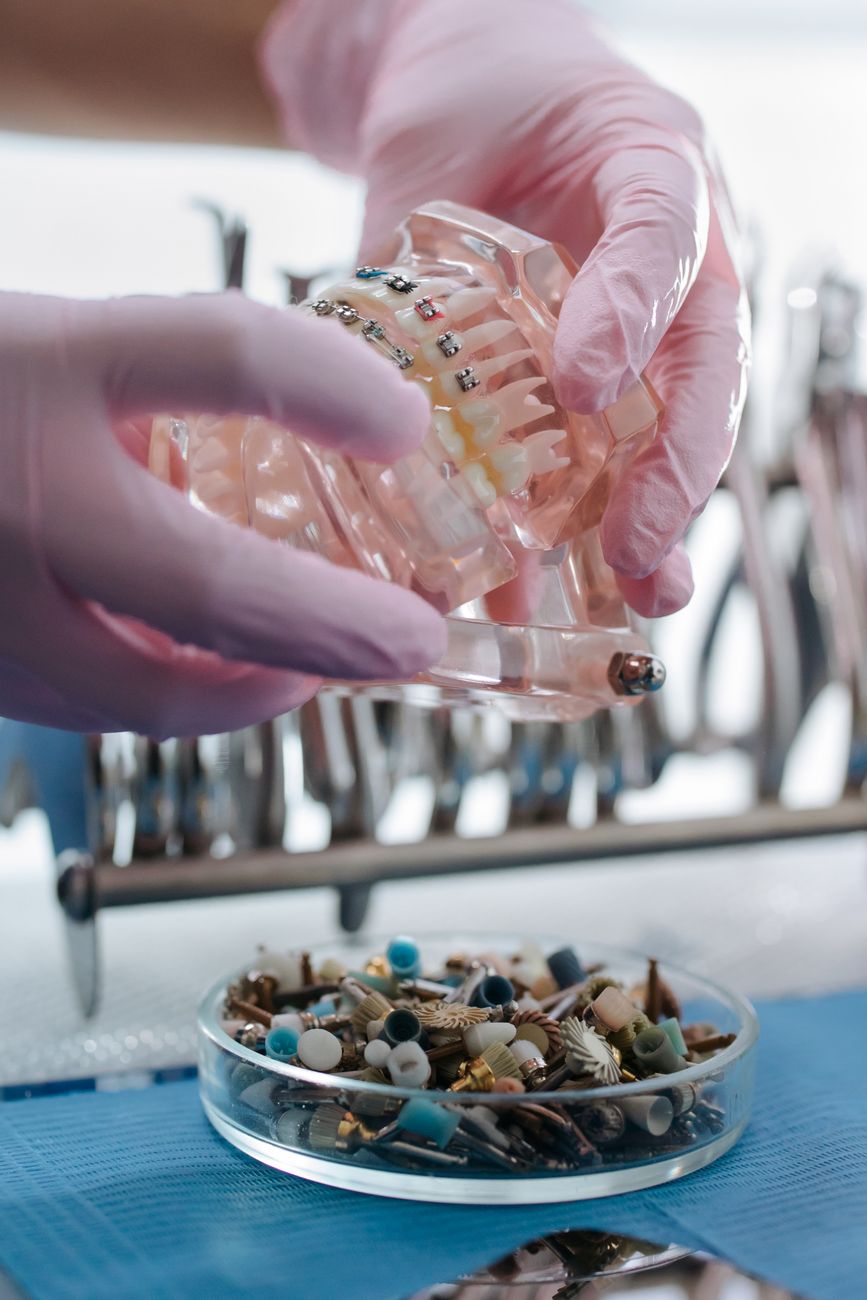
Bridge or Implant? How to Actually Choose
Clinically reviewed by Dr. Abinaash Kaur, DDS, RCDSO, on 2026-09-18. Dr. Kaur is a general dentist in Toronto (Bloor West Village) registered with the Royal College of Dental Surgeons of Ontario.
For one missing tooth with healthy teeth on either side, an implant is usually the better choice, because a traditional bridge means filing down those two healthy teeth to carry it. For every other situation, the answer depends on your bone, your gums, your general health, your timeline and your budget, and an exam sorts that out in one visit.
That first line surprises people, so here's where it comes from. The Canadian Dental Association says it on its own bridges page: as an alternative to a bridge, your dentist may suggest a single implant, and an implant "will prevent you from having to get your healthy teeth filed down in preparation for the crowns" (Canadian Dental Association).
Now the part that keeps this from being a sales pitch. A bridge is the right answer for a lot of people, and I'll spend as much of this page on when it is as on when it isn't.
What's the real difference between the two?
A bridge replaces the tooth. An implant replaces the root, and then the tooth goes on top of it.
A bridge, also called a fixed dental prosthesis, is a restoration that replaces one or more missing teeth by spanning the gap, and it's typically an artificial tooth fused between two crowns. It's held in place by your own teeth on each side, it's permanent, and it can't be removed (Canadian Dental Association).
An implant is different at the root. It's an artificial root made of titanium metal, inserted into the jawbone to replace the root of the natural tooth, and the replacement tooth attaches to it (Canadian Dental Association).
The timelines aren't in the same league either. A bridge takes two visits, with a temporary bridge in between to protect the prepared teeth (Canadian Dental Association). An implant is placed in the jawbone under the gum, then the tissue heals and the implant bonds with the bone, and that healing "can take several months" (Canadian Dental Association).
So one is weeks. The other is most of a year, fairly often.
Which one lasts longer?
Most people think an implant lasts forever and a bridge is the short-term patch. Here's what the numbers show.
A systematic review pooled the studies on both and reported ten-year survival of 89.2% for conventional tooth-supported bridges and 89.4% for implant-supported single crowns (Clinical Oral Implants Research via PubMed). At ten years those are the same number for any practical purpose.
Did you know about this? Almost nobody does, and it changes the conversation, because "which lasts longer" turns out to be a weaker question than "what does each one cost you along the way".
Complications are where they separate. In that same review, 38.7% of patients with implant-supported bridges had some complication within five years, against 15.7% for conventional bridges (Clinical Oral Implants Research via PubMed). The two lists look different too. For tooth-supported bridges the common problems were biological, meaning cavities and dying nerves in the teeth holding it up. For implant-supported work the common problems were technical: chipped porcelain, loose screws and abutments, lost retention (Clinical Oral Implants Research via PubMed).
For the everyday version of a bridge's lifespan, the Canadian Dental Association says that with good care it "should generally last for about 10 years, or perhaps longer" (Canadian Dental Association).
What does a bridge ask of the teeth next door?
Here's the trade-off that rarely makes it onto a treatment plan, and it's the one I'd want to hear first.
With a traditional bridge, if you have healthy teeth on each side of the gap, your dentist files down those two healthy teeth to prepare them for the bridge (Canadian Dental Association). Two teeth that were fine get reshaped to hold up a third.
Most of the time they tolerate it. A review and meta-analysis of live teeth, meaning teeth whose nerve is still healthy, used to support crowns and bridges found success rates, judged by examination and x-ray, of 92% to 98% across follow-up periods from 5 to 20 years (Journal of Prosthodontics via PubMed). Read the other side of that. Somewhere between two and eight of every hundred prepared teeth ran into pulp or root-tip trouble, and the fix for a tooth whose nerve gives out under a crown is root canal treatment.
Here's the part worth sitting with. If one abutment tooth fails years later, you don't lose one tooth. You can lose the bridge and face a bigger gap than you started with.
That risk is the honest price of a bridge. It isn't a reason to refuse one.
So when is a bridge the better answer?
Often. Three situations in particular.
The first is when the neighbouring teeth already need crowns. If both teeth beside the gap have big old fillings, cracks, or root canal treatment behind them, they're heading for crowns anyway. Preparing them for a bridge costs you nothing you weren't spending. That's the cleanest case for a bridge there is.
The second is when an implant isn't available to you, which the next section covers.
The third is time and surgery. Some people can't take months of healing, and some don't want a surgical procedure. Those are legitimate reasons, not weak ones.
Front teeth get their own option, and it's the most conservative of the lot. Resin-bonded bridges, also called Maryland bridges, are used when the missing tooth is at the front, and the artificial tooth is fused to metal bands cemented to the back of your natural teeth (Canadian Dental Association).
The evidence behind them is decent. A review of the ceramic versions concluded that cantilever resin-bonded bridges in the front "are a less invasive and valuable treatment option, providing good esthetic results", with zirconia and glass-infiltrated alumina versions surviving up to 10 and 15 years (Journal of Esthetic and Restorative Dentistry via PubMed).
Ask about it by name if your gap is at the front.
Who isn't a good candidate for an implant?
The requirements are specific. If you're in good general health, have healthy gums and have enough bone in the jaw to hold an implant, implants might be right for you (Canadian Dental Association).
Bone is the usual sticking point. If the jawbone has shrunk or never developed normally, a bone graft can add new bone to build it back up (Canadian Dental Association), and that adds time and cost to the plan.
Gums matter more than most people expect. Peri-implantitis is inflammation and bone loss around an implant, and a review of 57 studies put its prevalence at 19.53% of patients (BMC Oral Health via PubMed). Roughly one in five is not a rounding error.
What moves that number is partly in your hands. Another review of 57 studies found median peri-implantitis of 9.0% among people who kept up a regular prevention program, against 18.8% for people without regular maintenance, and 14.3% among people with a history of gum disease. Smoking, diabetes, missed maintenance and past gum disease all came out as risk factors (Journal of Periodontal Research via PubMed).
Implants can also go wrong in ordinary ways. Complications are rare but include bleeding, infection, numbness, injury to nearby muscles or the sinus cavity, and sometimes the implant doesn't bond to the bone at all (Canadian Dental Association).
If you smoke, have gum disease that isn't under control, or you're not going to come in for cleanings, a bridge may genuinely serve you better. I'd rather say that than sell you a titanium root that needs care you've told me you won't give it.
Does waiting change what's possible?
Yes, and the timing catches people out.
A jaw doesn't hold the shape of a gap. A systematic review of human re-entry studies found horizontal bone loss of 29% to 63% and vertical bone loss of 11% to 22% in the six months after a tooth is taken out, with the fastest changes in the first three to six months and slower changes after that (Clinical Oral Implants Research via PubMed).
Read what that means for the decision rather than for your anxiety. The ridge shrinks whether you choose a bridge, an implant or nothing, so the numbers above aren't a scare about leaving a gap.
It's about sequencing. The bone you have at month three isn't the bone you'll have at year three, and an implant plan started later is likelier to include a graft.
If you've already waited years, have no fear. Plenty of my patients have, and grafting exists for exactly that reason. It's worth knowing before you're told the price.
What do these cost in Toronto, and will insurance help?
In my experience across Toronto offices in 2026, a three-unit bridge runs about $3,000 to $5,500, because you're paying for three units: two crowns and the tooth between them. A single implant with the post, abutment and crown runs about $3,000 to $6,500, and grafting adds to that. Those are ballparks from my chair, not quotes, and the only real number comes from an exam.
Pretty much every bridge-versus-implant quote lands in the same neighbourhood. The choice isn't usually a money decision at the single-tooth level, whatever the brochures suggest.
Insurance is where it gets frustrating, and the Canadian Dental Care Plan is blunt about it. Its exclusion list names "fixed prosthodontics (bridges and all bridge related procedures)", "implants and all implant-related procedures", and "bone grafts" (Government of Canada). The plan does cover complete dentures, and partial dentures with preauthorization (Government of Canada). So under that plan, the covered way to replace a missing tooth is removable. We've written more on what the CDCP does and doesn't do with crowns and bridges.
Private plans vary a lot on both, so read your booklet or bring it in and we'll help you decode it. Our guide to how dental costs work with OHIP and private insurance goes deeper, and our implant cost breakdown itemizes where an implant quote comes from.
How do you make the call in the chair?
Four questions, and they're the same four I ask myself.
Are the teeth beside the gap already compromised? If yes, a bridge stops costing you anything extra. If they're untouched, cutting them is a real loss and the case for an implant gets strong.
Is there enough bone and healthy gum? If no, you're choosing between grafting first or a bridge now.
Can you maintain it? Both need daily care. A bridge needs a floss threader to clean under and around the artificial tooth, and your dentist will show you how (Canadian Dental Association). An implant needs the same brushing and flossing as a natural tooth, plus regular checkups so the bite and the fit stay right (Canadian Dental Association).
What's your timeline? A wedding in eight weeks and a months-long healing period don't fit together.
Some days the schedule pushes me, and even then this conversation gets its own appointment, because deciding in four minutes with a suction tube in your mouth isn't deciding. In about 25 years in Bloor West Village I've placed plenty of both, and I've talked people out of both. If a quote arrives with one option on it and no reasoning, ask why the other one was ruled out. That's a fair question in any office, and our guide on how to tell whether treatment is being oversold has more ways to ask it.
Frequently Asked Questions
Q: Is an implant always better than a bridge? No. At ten years, survival was 89.2% for conventional tooth-supported bridges and 89.4% for implant-supported single crowns, which is the same number for practical purposes (Clinical Oral Implants Research via PubMed). An implant avoids filing down the neighbouring teeth (Canadian Dental Association), which is its main advantage for a single gap. A bridge wins when those teeth already need crowns, when there isn't enough bone, or when months of healing don't work for you.
Q: Does a bridge damage the teeth holding it? It changes them permanently, and usually they cope. A meta-analysis of live teeth used to support crowns and bridges reported success rates of 92% to 98% over follow-ups from 5 to 20 years (Journal of Prosthodontics via PubMed). The rest ran into pulp or root-tip problems, which is why the review of bridge outcomes lists cavities and dying nerves as the most frequent biological complications of tooth-supported bridges (Clinical Oral Implants Research via PubMed).
Q: How long does each one take from start to finish? A bridge is typically two visits, with a temporary bridge protecting the prepared teeth in between (Canadian Dental Association). An implant is placed into the jawbone first and the tissue then has to heal and bond to it, which "can take several months", followed by the abutment and the replacement tooth over further appointments (Canadian Dental Association).
Q: Can I get an implant if I've been missing the tooth for years? Often yes, sometimes with a graft first. Human re-entry studies found 29% to 63% horizontal and 11% to 22% vertical bone loss in the six months after an extraction, fastest in the first three to six months (Clinical Oral Implants Research via PubMed). A bone graft adds new bone to a jaw that has shrunk, and your dentist or specialist will tell you whether it can be done in your case (Canadian Dental Association).
Q: Does the Canadian Dental Care Plan cover a bridge or an implant? Neither. The plan's exclusion list names "fixed prosthodontics (bridges and all bridge related procedures)", "implants and all implant-related procedures", and "bone grafts" (Government of Canada). Complete dentures are covered, and partial dentures are covered with preauthorization (Government of Canada), so the covered route to replacing a missing tooth under that plan is a removable one. Private plans differ, so check your own booklet.
Q: I smoke. Should I still consider an implant? Talk it through rather than ruling it in or out on a web page. A review of 57 studies identified smoking, diabetes, a lack of regular prevention appointments and a history of gum disease as risk factors for peri-implantitis, and found median peri-implantitis of 9.0% among people in a regular prevention program against 18.8% among people without regular maintenance (Journal of Periodontal Research via PubMed). Implants aren't off the table for smokers, they just come with a maintenance plan you need to want.
Reviewed by Dr. Abinaash Kaur, B.Sc., DDS (University of Toronto Faculty of Dentistry), who has practised general and family dentistry in Bloor West Village for about 25 years. This article is general oral health information, not a diagnosis or a substitute for an examination.
Holding a treatment plan with one option on it and wondering about the other? Come in and we'll look at the gap, the teeth on either side, and the bone underneath, then lay both options out with real numbers and honest trade-offs. If a bridge is the better answer for your mouth, that's what we'll tell you. We're at 750 Annette Street in Bloor West Village, serving the Junction, High Park, and Baby Point. Book a consultation with The Village Dentist and let's work out which one fits.
