Dental Implants Cost in Toronto: 2026 Price Guide
Clinically reviewed by Dr. Abinaash Kaur, DDS, RCDSO, on 2026-07-21. Dr. Kaur is a general dentist in Toronto (Bloor West Village) registered with the Royal College of Dental Surgeons of Ontario.
Dental Implants Cost in Toronto: 2026 Price Guide
In Toronto in 2026, a single dental implant usually costs $3,000 to $6,500 all-in, meaning the post, the abutment, and the crown together. That is the range I see across Toronto offices, and it sits at the top of the $1,000 to $6,000 per-tooth national range that insurer guides publish (Canada Life). Full-arch options like All-on-4 run roughly $25,000 to $35,000 per arch, and All-on-6 sits higher again. One thing surprises most cardholders: the Canadian Dental Care Plan (CDCP) does not cover implants. They are an explicit exclusion (Canada.ca CDCP Dental Benefits Guide). So most patients pay out of pocket or finance. I have practised in Bloor West Village for more than two decades, and I would rather give you the honest number up front.What a dental implant is (and why one tooth has three price tags)
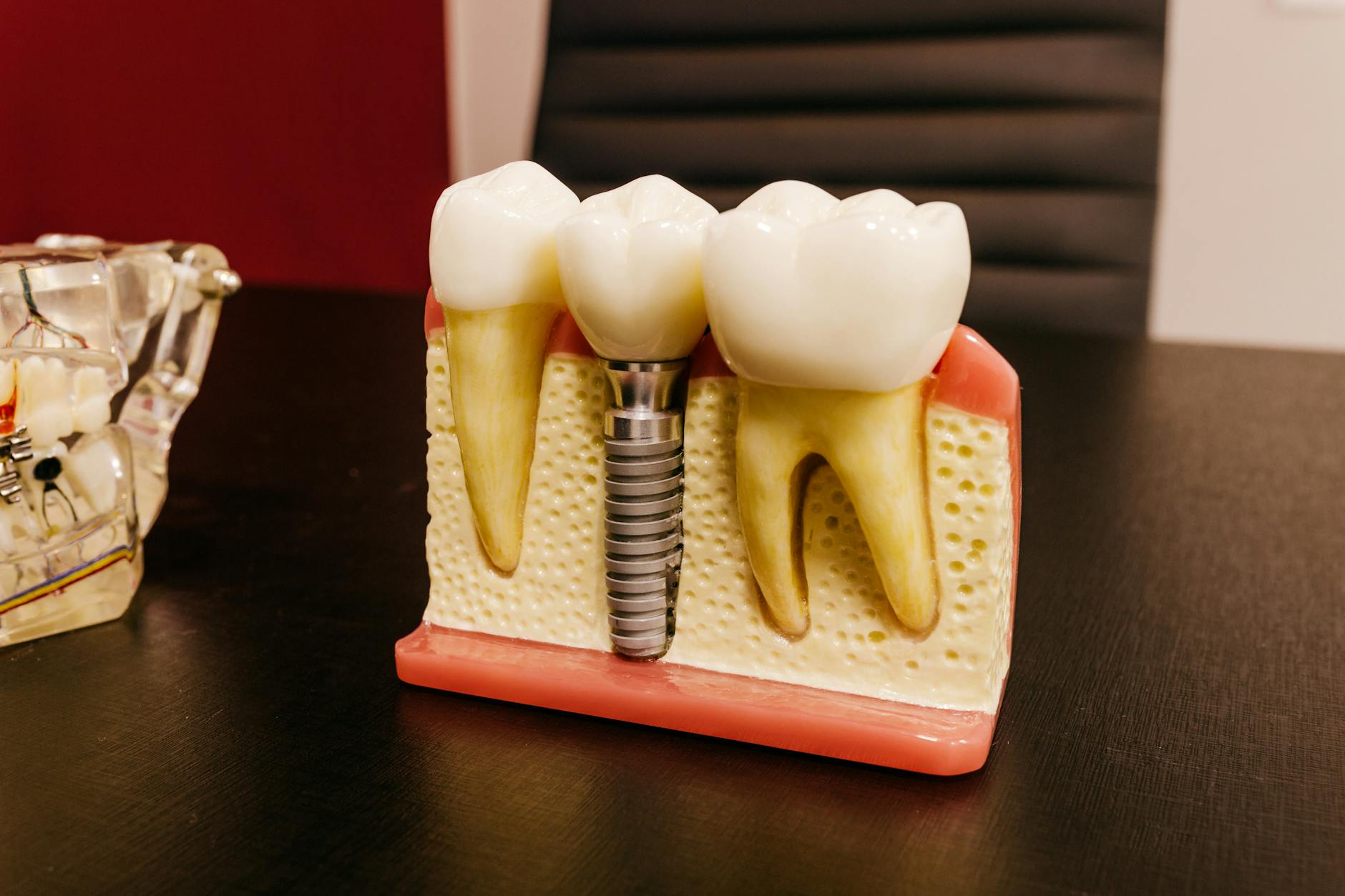
Did you know one missing tooth has three separate bills attached to it? Most people picture one screw and one price. What gives? An implant is three bills, not one. A dental implant is a titanium or zirconia post that a dentist surgically places in your jawbone. Over a few months it fuses to the bone, a process called osseointegration. Then an abutment connects to the post, and a crown sits on top. The crown is the only part you see.The three components: fixture, abutment, crown
The surgical fixture is the post in the bone. The abutment is the connector. The crown is the visible tooth. Each one is a different lab process, a different material, and a different billing code. When a patient asks what an implant costs, my honest answer starts with a question back: which part?Why the quote you get is a bundle
The single number you see on a quote is three parts plus the surgery plus the 3D imaging. That is why two offices can quote different totals for the same tooth. One office might bundle the crown. Another might quote the post alone and add the rest later. You cannot understand the price until you understand the parts. Have no fear.How much do dental implants cost in Toronto in 2026?
Comparing prices before you book? Smart. In short: a single implant runs about $3,000 to $6,500 all-in, and full-arch options like All-on-4 run roughly $25,000 to $35,000 per arch. Here are the ranges I see across the city.Single-tooth implant: the all-in range
A single tooth implant in Toronto runs $3,000 to $6,500 all-in, covering the post, the abutment, and the crown. That is what I see quoted across Toronto offices in 2026. For context, national insurer guides put a single implant anywhere from about $1,000 to $6,000 per tooth, varying with the provider, the case, and where you live (Canada Life). Toronto pricing and all-in bundling both push toward the top of that. The spread is wide because materials, the brand of implant, and your specific anatomy all move the number.Full-arch and All-on-4 / All-on-6
Replacing a whole arch is a different scale. All-on-4 uses four implants to anchor a full set of teeth and, in my experience across Toronto offices, runs roughly $25,000 to $35,000 per arch. All-on-6 uses six implants and lands higher again, often in the $30,000 to $50,000 per-arch range. Treat both as a ballpark from my office, not a quote. The total depends on materials, the number of implants, and whether you need grafting first.The ODA Suggested Fee Guide reference point
The Ontario Dental Association publishes a Suggested Fee Guide every year that acts as a reference for hundreds of procedures (Ontario Dental Association). The guide itself is distributed to dentists, not published as a public price list, which is one more reason online numbers vary. Most people think there is a fixed legal price for an implant in Ontario. There is not. Ontario dentists set their own fees, and the guide is suggested, not mandatory (RCDSO patient resource). If a dentist charges above the guide, RCDSO expects them to discuss those fees with you openly (RCDSO patient resource). So shopping on price alone is risky, because the cheapest quote often leaves parts out. A component breakdown helps you read any quote: | Component | Single tooth | All-on-4 (per arch) | All-on-6 (per arch) | |---|---|---|---| | Surgical fixture (post) | $1,000-$2,500 | 4 fixtures included | 6 fixtures included | | Abutment(s) | $500-$1,200 | included in arch fee | included in arch fee | | Crown / prosthesis | $1,200-$2,800 | full-arch bridge included | full-arch bridge included | | 3D imaging + surgery | included or added | included | included | | All-in range | $3,000-$6,500 | $25,000-$35,000 | $30,000-$50,000 | The all-in totals reflect what I see across Toronto offices in 2026, cross-checked against the national per-tooth range insurers publish (Canada Life) and framed by the ODA Suggested Fee Guide as the standard reference point. The per-component splits are a rough range from my office to help you read a quote, not a quote themselves. Every mouth is different, and only an exam gives you a real number.The hidden costs: bone grafting, sinus lifts, extractions and sedation
Why did your friend's implant cost more than the number you saw online? Usually it is the add-ons. These are the procedures that quietly move the total.When you need a bone graft or sinus lift
Bone graft. A bone graft rebuilds jawbone that has shrunk after a tooth is gone. Without enough bone, an implant has nothing to hold onto. A sinus lift adds bone in the upper back jaw where the sinus sits low. Ridge augmentation rebuilds a thinned-out ridge. Each of these adds cost, in my experience often $500 to $3,000 depending on the size of the area, which is a ballpark from my office rather than a guide figure. Pretty much every big jump in a quote traces back to one of these.Extractions, temporaries and sedation
Sometimes the tooth has to come out first, which is its own fee. You may want a temporary crown so you are not walking around with a gap while the post heals. Some patients want IV sedation, which adds cost too. Not everyone needs all of this. In more than two decades I have learned not to assume. A 3D CBCT scan at your consult tells us whether you need a graft or a lift, or whether your bone is ready as-is.Does CDCP cover dental implants? The honest answer
The Canadian Dental Care Plan does not cover dental implants. No part of one. I know that is not what a lot of cardholders want to hear, so let me be precise.Implants are an explicit CDCP exclusion
Implants, implant-supported complete and partial dentures, and ridge augmentation are all listed as exclusions in the Canada.ca CDCP Dental Benefits Guide. The government plan will not pay for any part of an implant. Not the screw in the bone. Not the surgery. Not the crown on top. If you want the full picture of how the plan works, our Canadian Dental Care Plan guide and our walkthrough on how to apply for CDCP in 2026 cover eligibility and renewal in plain language.What CDCP does cover for missing teeth (dentures)
Here is the part most patients miss. CDCP covers complete and partial dentures, including a three-month post-insertion care period, subject to your CDCP co-pay tier and the plan's approval rules (Canada.ca, what services are covered). So if you are a cardholder and you are missing teeth, dentures are your covered tooth-replacement route. Implants are not. That is a real difference in your out-of-pocket cost, and it should be part of your decision. Our breakdown of how dental costs work with OHIP, CDCP and insurance in Toronto goes deeper on what fits together.Why the screw, surgery and crown are all excluded
Why exclude implants entirely? The plan covers basic and some major restorative care, and implants are classified as advanced, elective restorative work. That puts them outside the plan's scope. Ridge augmentation, the ridge-rebuilding step from earlier, is named as an exclusion too. With implant-supported dentures, the implants and the surgery stay excluded, full stop. Do not assume the plan will help with implants. It will not.How to finance dental implants in Toronto
So if CDCP is out, how do people pay for this? Most pay with a mix of insurance, a plan, and patience.Private insurance and the annual maximum
Private or employer insurance is different from CDCP. It may cover a portion of implants, often a percentage up to an annual maximum, depending on your plan. Read your specific policy, because some cover implants and some do not. This is the one path where coverage might apply, unlike CDCP, which excludes them outright (Canada.ca CDCP Dental Benefits Guide).Payment plans, financing and HSAs
Common options include in-office payment plans, third-party dental financing, and Health Spending Accounts. Each spreads the cost over time so you are not paying it all at once. We talk through these openly at the office, no pressure to decide on the spot.Phasing treatment to spread cost
One practical move many people miss: you can stage treatment across two benefit years to use two annual maximums. Ask for a written treatment plan with the diagnostic codes on it. You can submit that to your insurer as a pre-determination before you commit a dollar. Try this: get the written plan first, then decide.Are dental implants worth the cost? What the long-term data says
For the right patient, yes, and the long-term data backs it up. Let me show you the numbers.10-year survival rates
A systematic review and meta-analysis put the 10-year implant survival rate at 96.4% at the implant level, meaning the device itself stays in place (PubMed). A separate long-term study of 511 titanium implants reported a 10-year survival rate of 98.8% (PubMed). Survival counts the implant staying in service, which is not the same as zero maintenance. They are still among the most durable restorations we do.Cost-per-year vs repeat work on cheaper options
Think about cost per year, not just the sticker. A well-maintained implant can last decades. Bridges and dentures usually get relined or replaced over time, so the cheaper option can cost more across 20 years. Success is not automatic, though. It depends on bone health, oral hygiene, not smoking, and regular maintenance. I would rather a patient wait and do it right than rush a cheap version that fails.Single tooth, bridge, denture or implant: choosing the right option
Which option fits you depends on your budget, your bone, and your coverage. There is no single right answer for everyone.When an implant is the best value
An implant preserves jawbone, stands alone without grinding down neighbouring teeth, and lasts the longest. If you have the bone and the budget, it is often the best long-term value.When a denture or bridge makes more sense
For some patients, a quality denture is the right call. Maybe the budget is tight. Maybe you are a CDCP cardholder, and the denture is covered while the implant is not (Canada.ca, what services are covered). Maybe a complex medical history makes surgery less appealing. A good denture is a real fix. My job is to give you the recommendation I would give my own family, not to default everyone to implants. For honest cost breakdowns on other treatments, see our cost guide on Invisalign in Baby Point, and our guide to oral surgery and extractions.Getting an implant in Bloor West Village: what a consult looks like
What happens when you come in? No mystery. Here is the sequence.The exam, 3D scan and personalized quote
We start with your medical history and a clinical exam. Then a 3D CBCT scan shows us your bone, your nerves, and your sinuses. From there I can tell you whether you need a graft or a lift, and we write up an itemized quote with real numbers on it. That written quote is the only price that means anything. Online ranges get you in the ballpark. Only the scan gives a real number.Booking at The Village Dentist in Bloor West Village
We are at 750 Annette Street in Bloor West Village, near the Junction, serving High Park and Baby Point. Some days the schedule pushes me, and even then we take the time you need. If you are facing an extraction or you have lived with a gap long enough, come in and let us look. Book a consult with us at The Village Dentist, and we will tell you exactly what your case involves and what it will cost.Frequently Asked Questions
Q: How much does a single dental implant cost in Toronto in 2026? A single dental implant in Toronto typically costs $3,000 to $6,500 all-in, covering the titanium post, the abutment, and the crown. That is the range we see across Toronto offices, at the top of the $1,000 to $6,000 national per-tooth range insurers publish (Canada Life). Ontario dentists set their own fees (RCDSO), so the only accurate number comes from an exam. Q: How much does All-on-4 or full-mouth dental implants cost in Toronto? Full-arch implant options run roughly $25,000 to $35,000 per arch for All-on-4, and All-on-6 commonly lands around $30,000 to $50,000 per arch, in our experience across Toronto offices. The total depends on materials, the number of implants, and whether grafting is needed. Q: Does CDCP cover dental implants? No. The Canadian Dental Care Plan does not cover dental implants. Implants, implant-supported dentures, and ridge augmentation are explicit exclusions (Canada.ca CDCP Dental Benefits Guide), so CDCP pays for none of it, not the screw, the surgery, or the crown. CDCP does cover complete and partial dentures. Q: What does CDCP cover for missing teeth instead of implants? For replacing missing teeth, CDCP covers complete and partial dentures, including a three-month post-insertion care period, subject to your co-pay tier (Canada.ca). Dentures are the CDCP-covered tooth-replacement route; implants remain fully out of pocket or financed privately. Q: Why are dental implants so expensive? An implant is three billable parts, the surgical fixture, the abutment, and the crown, plus surgery, 3D imaging, and sometimes bone grafting or a sinus lift. Each component and add-on adds to the total, which is why quotes vary between offices and providers (Canada Life). Q: Can I finance dental implants in Toronto? Yes. Common options include in-office payment plans, third-party dental financing, Health Spending Accounts, and staging treatment across two benefit years. Private or employer insurance may also cover a portion of implants, unlike CDCP, which excludes them entirely (Canada.ca CDCP Dental Benefits Guide). Q: How long do dental implants last? Dental implants are among the most durable restorations in dentistry, with a 10-year survival rate of 96.4% at the implant level in a systematic review (PubMed) and 98.8% in a study of 511 titanium implants (PubMed). With good oral hygiene, regular maintenance, and not smoking, many implants last decades, which improves their cost-per-year value. Q: Is a dental implant or a denture the better choice? It depends on your budget, bone health, and coverage. Implants preserve jawbone and last longer but cost more and are not covered by CDCP. A quality denture costs less, is CDCP-covered (Canada.ca), and can be the right call for some patients. A consult determines the best fit.Reviewed by Dr. Abinaash Kaur, B.Sc., DDS (University of Toronto Faculty of Dentistry), who has practised general and restorative dentistry in Bloor West Village for more than two decades. This article is general information, not a diagnosis or a quote. Book a consult for advice on your specific case. Thinking about replacing a missing tooth? Learn how dental implants at The Village Dentist work, and book a free implant consultation for a written personal quote.
Related reading: 2026 Toronto prices across every common treatment
