Can AI Spot a Cavity From a Photo?
Clinically reviewed by Dr. Abinaash Kaur, DDS, RCDSO, on 2026-10-01. Dr. Kaur is a general dentist in Toronto (Bloor West Village) registered with the Royal College of Dental Surgeons of Ontario.
Sometimes, and mostly on the easy ones. AI does reasonably well on clear photos of the biting surfaces of back teeth, but ordinary phone photos give the weakest results, and no photo can see between your teeth.
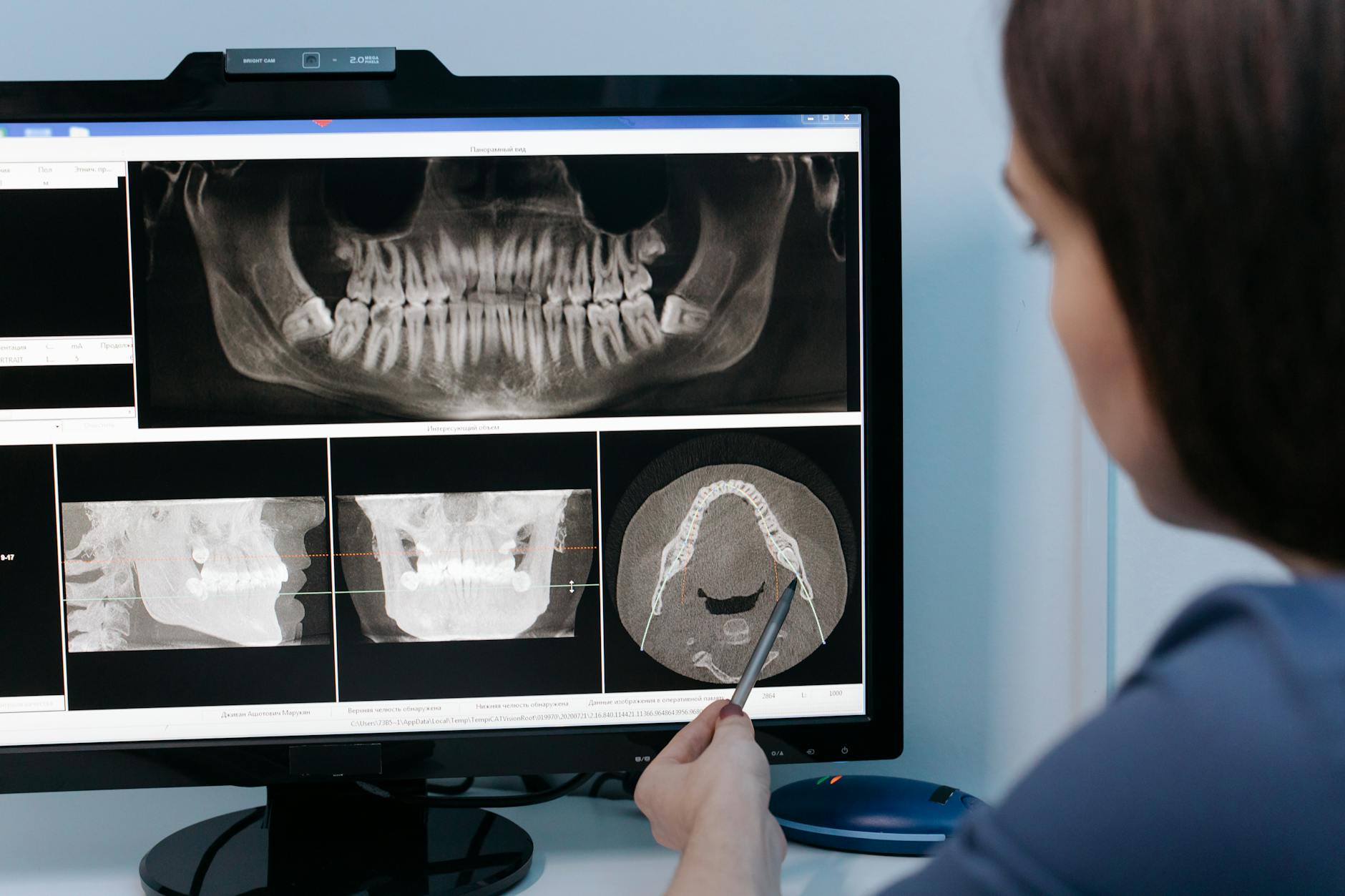
Where AI earns its keep is as a second set of eyes on X-rays. Even there, a dentist still has to make the call.
Here's what the studies show, what Ontario's dental regulator expects, and what to ask if a screen ever tells you there's a cavity.
What does the research say about phone photos?
The best summary comes from close to home. A team at the University of Toronto's Faculty of Dentistry pulled together 19 studies of AI reading photos of teeth (Oral Diseases via PubMed).
They compared the programs using an F1 score, a single number that balances missed cavities against false alarms. With professional cameras, scores ran from 68.3% to 95.4%. With smartphone cameras, they ran from 42.8% to 80% (Oral Diseases via PubMed).
The phone in your pocket was the weakest camera in the review.
The authors were candid about the evidence, too. Only six of the 19 studies had a low risk of bias in every area they checked, and few studies let them judge how AI did on cavities of different sizes (Oral Diseases via PubMed).
A wider review pooled eight earlier reviews, with data up to June 2024. AI on mouth photos caught between 67% and 96% of real cavities, and correctly cleared healthy teeth 75% to 99.2% of the time (Journal of Oral Biology and Craniofacial Research via PubMed).
Those authors read their results as good news, and they rated the overall risk of bias as minimal (Journal of Oral Biology and Craniofacial Research via PubMed). My read is different, and it's my opinion, not theirs: a tool that catches 67% of cavities in one study and 96% in another can't tell you which of those you've downloaded.
Can a chatbot like ChatGPT or Gemini read your photo?
It's the obvious thing to try, and researchers from the same Toronto faculty tested it in 2026. They gave Gemini 3.1, a general-purpose AI model with no dental training, 1,255 public photos of teeth and compared its answers with markings made by experts (International Dental Journal via PubMed).
Asked whether a photo had a cavity anywhere in it, the model did well. With no examples to learn from, it found 95% of them (International Dental Journal via PubMed).
Pointing to the right tooth was another story. At the tooth level, its precision was 0.49, so fewer than half of the teeth it flagged matched a cavity the experts had marked (International Dental Journal via PubMed).
The researchers named the pattern themselves: the model showed a "tendency toward over-detection" (International Dental Journal via PubMed). Reliable results showed up mainly with the reasoning versions of the model, on photos of the biting surfaces (International Dental Journal via PubMed).
In plain terms, a chatbot reading your selfie leans toward false alarms. The authors said it needs "rigorous clinical validation and governance before real-world deployment as a public screening tool" (International Dental Journal via PubMed).
What can't a photo see?
Most people think a cavity is a dark spot you'd notice in the mirror. Here's what happens instead.
Plenty of cavities start where two back teeth touch. A camera can't get between them. Decay can also creep under the edge of an old filling or a crown, where the surface looks fine from outside.
A dark line in a groove can be stain that isn't decay at all. A chalky white patch can be an early spot that may still harden back up, which I explained in my post on whether a cavity can heal itself.
What gives? A photo is a picture of the outside of a tooth, and cavities are a problem of the inside.
That gap is why we use bitewing X-rays (the small side-by-side X-rays of your back teeth) to look between teeth. If the radiation worries you, I've covered how much dental X-rays expose you to.
Where is AI useful in a dental office?
On X-rays, as a second reader.
AI cavity detection software is a program that marks possible cavities on an X-ray image. It learns from X-rays that experts have already marked, then flags spots that look similar.
The best test I know of is a randomized trial with 22 dentists reading bitewing X-rays, sometimes with a commercial AI program called dentalXrai Pro and sometimes without it (Journal of Dentistry via PubMed).
With AI, the dentists caught 81% of cavities. Without it, they caught 72%. Their accuracy on healthy surfaces didn't change significantly (Journal of Dentistry via PubMed).
The gain came in early cavities in the enamel (the hard outer layer), not in deeper ones that had reached the dentin (the softer layer underneath) (Journal of Dentistry via PubMed).
One disclosure belongs next to those numbers. A later trial from the same research group states that its senior author, who was also the senior author of the first trial, co-founded dentalXrai, the company behind the software, and that the company had no role in that later study (Journal of Dentistry via PubMed).
If the AI found more, does that mean more fillings?
The trial's next finding is the one I'd want every patient to hear.
The dentists using AI found more early cavities, and they also made more treatment decisions of every kind. The researchers wrote that "Higher sensitivity came with an increase in non-invasive, but also invasive treatment decisions" (Journal of Dentistry via PubMed). Invasive here means drilling and filling.
The same team then modelled what those decisions would mean over a lifetime. Teeth lasted the same 49 years on average with or without AI, and the cost came out at about 330 euros either way (Journal of Dentistry via PubMed).
Their conclusion: "Higher accuracy of AI did not lead to higher cost-effectiveness, as more invasive treatment approaches generated costs and diminished possible effectiveness advantages" (Journal of Dentistry via PubMed).
Finding a spot sooner only helps if the spot gets the right treatment.
Many early enamel spots do better with fluoride, cleaning, and a recheck than with a drill. If you've ever wondered whether a long treatment plan is all necessary, I've written about how to tell if your dentist is upselling you.
Ontario's dental regulator is clear on this point. The Royal College of Dental Surgeons of Ontario says dentists can be held responsible for professional misconduct while using AI, "for example, if they recommend or provide an unnecessary dental service" (Royal College of Dental Surgeons of Ontario).
Is a cavity app regulated in Canada?
It depends on what the app says it does.
Health Canada treats software as a medical device when the maker's represented use is a medical purpose, such as diagnosing a disease. That kind of software can run on ordinary computing platforms, and the guidance lists applications on mobile phones as an example (Health Canada). How it's classified depends on the maker's labelled intended use (Health Canada).
On April 1, 2026, Health Canada published guidance for makers of machine learning medical devices applying for a Class II, III or IV licence (Health Canada).
The college puts the licence in context. Health Canada approval means the maker has shown its device is safe and effective, including through testing and clinical validation. It adds: "While many AI-enabled medical devices have been approved, not all AI tools qualify as medical devices" (Royal College of Dental Surgeons of Ontario).
My reading, as a dentist and not a regulator: an app whose maker never claims it diagnoses anything may never have been reviewed as a diagnostic tool. Read the small print before you trust the verdict.
What should you ask if your dentist uses AI?
Start with the basics. In Ontario, "AI is not required for dentists to provide competent and quality care to patients" (Royal College of Dental Surgeons of Ontario). The college approved its AI in Dentistry Guidance in September 2025 (Royal College of Dental Surgeons of Ontario).
The dentist stays on the hook. The college says AI tools "can still produce inaccurate, incomplete, or misleading results," and that dentists are expected to override AI output when it's wrong (Royal College of Dental Surgeons of Ontario). Its guidance also recommends that dentists tell patients when they're using AI for clinical care (Royal College of Dental Surgeons of Ontario).
Have no fear about asking questions. Try this:
- Can you show me the spot on the X-ray, and do you see it too?
- Is it in the enamel, or has it reached the layer underneath?
- Could we treat it with fluoride and recheck it, instead of filling it now?
- When would we look at it again?
In about 25 years of practice in Bloor West Village, I've learned that a cavity is a judgement call made with your history in mind. On a day when the schedule is running behind, a program that flags spots in seconds is tempting. The exam still takes the time it takes, and a box on a screen isn't a diagnosis until someone who knows your teeth agrees with it.
Frequently Asked Questions
Q: Can I send a photo of my tooth to an AI app to check for a cavity? You can, but don't treat the answer as a diagnosis. In a University of Toronto-led review of 19 studies, AI scored 42.8% to 80% on smartphone photos, the lowest range of any camera type (Oral Diseases via PubMed). A photo also can't see between teeth or under old fillings. If something hurts or looks wrong, book an exam.
Q: Is AI better than a dentist at finding cavities? It's better used with a dentist than instead of one. In a randomized trial, dentists using AI on bitewing X-rays caught 81% of cavities, against 72% without it, mostly early ones in the enamel (Journal of Dentistry via PubMed). The same dentists also made more decisions to drill and fill.
Q: Can ChatGPT or Gemini tell me if I have a cavity? Not reliably. When researchers tested Gemini 3.1 on 1,255 photos of teeth, fewer than half of the teeth it flagged matched a cavity marked by experts, and the authors described a "tendency toward over-detection" (International Dental Journal via PubMed). A chatbot is more likely to worry you than to clear you.
Q: Does my dentist have to use AI? No. Ontario's dental regulator states that "AI is not required for dentists to provide competent and quality care to patients" (Royal College of Dental Surgeons of Ontario). If a dentist does use it, the college recommends telling patients, and the dentist remains responsible for the diagnosis.
Q: The AI on my X-ray flagged a spot. Do I need a filling? Not automatically. In the trial that tested AI on X-rays, the extra cavities found were mostly early enamel spots (Journal of Dentistry via PubMed), and in a lifetime model of that trial the extra drilling meant teeth lasted no longer and cost no less over a lifetime (Journal of Dentistry via PubMed). Ask whether the spot is in the enamel and whether it can be treated with fluoride and rechecked first.
Reviewed by Dr. Abinaash Kaur, B.Sc., DDS (University of Toronto Faculty of Dentistry), who has practised general and family dentistry in Bloor West Village for about 25 years. This article is general oral health information, not a diagnosis or a substitute for an examination.
Got a photo or an app result that's bothering you? Bring it in and we'll look at the tooth itself, take an X-ray if it's needed, and talk through whether that spot needs a filling or just watching. We're at 750 Annette Street in Bloor West Village, serving the Junction, High Park, and Baby Point. Book a visit with The Village Dentist and we'll give you a straight answer.
