
What Does Measles Look Like in Your Mouth?
Clinically reviewed by Dr. Abinaash Kaur, DDS, RCDSO, on 2026-09-14. Dr. Kaur is a general dentist in Toronto (Bloor West Village) registered with the Royal College of Dental Surgeons of Ontario.
Small white or bluish-white spots sitting on a patch of red, on the inside of your cheek, usually across from your back teeth. They're called Koplik spots, and the reason they're worth knowing about is timing. They turn up before the rash does.
That's why a dental office is one of the odd places measles occasionally gets noticed first.
Here's the part that belongs before everything else, because it's the part that gets lost. If you think you or your child has measles, don't come in to see us. Phone your doctor or your local public health unit, and call ahead to any health care office rather than sitting in a waiting room (Public Health Ontario).
I've practised in Bloor West Village for about 25 years, and measles wasn't on my list of things I expected to write about. It is now. Canada lost its measles elimination status on 10 November 2025, after the same strain kept spreading here for more than twelve months (Public Health Ontario).
What do Koplik spots actually look like?
Tiny spots, roughly two to three millimetres across, bluish-white on an inflamed red base (StatPearls via NCBI Bookshelf). The classic location is the inside of the cheek, opposite the first molar.
The College of Dental Hygienists of Ontario describes them as small, often irregularly shaped, with white or bluish-white centres on a red base, appearing two or three days after the fever, cough and runny nose start, and before the rash arrives (CDHO). CDHO calls them flat lesions, and they multiply quickly and run together into small patches.
Textbooks describe the look as grains of salt scattered on a red background (StatPearls via NCBI Bookshelf).
The red base is the part doing the work in that description. White things in a mouth are common. White specks on an inflamed red background, in someone who's running a fever, are not.
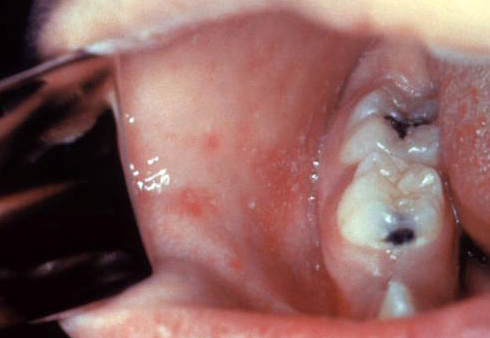
Did you know about this? Most people have never heard of Koplik spots, including plenty of people who had measles as children.
Why would a dentist see them before the rash?
Because of a gap of a day or two, and because of where the spots sit.
Koplik spots usually appear two to three days after the first cold-like symptoms, and one to two days before the rash (Public Health Agency of Canada). Someone inside that window feels like they've caught a bad cold. Nobody looks like a measles case yet, so a cleaning booked three months ago doesn't get cancelled.
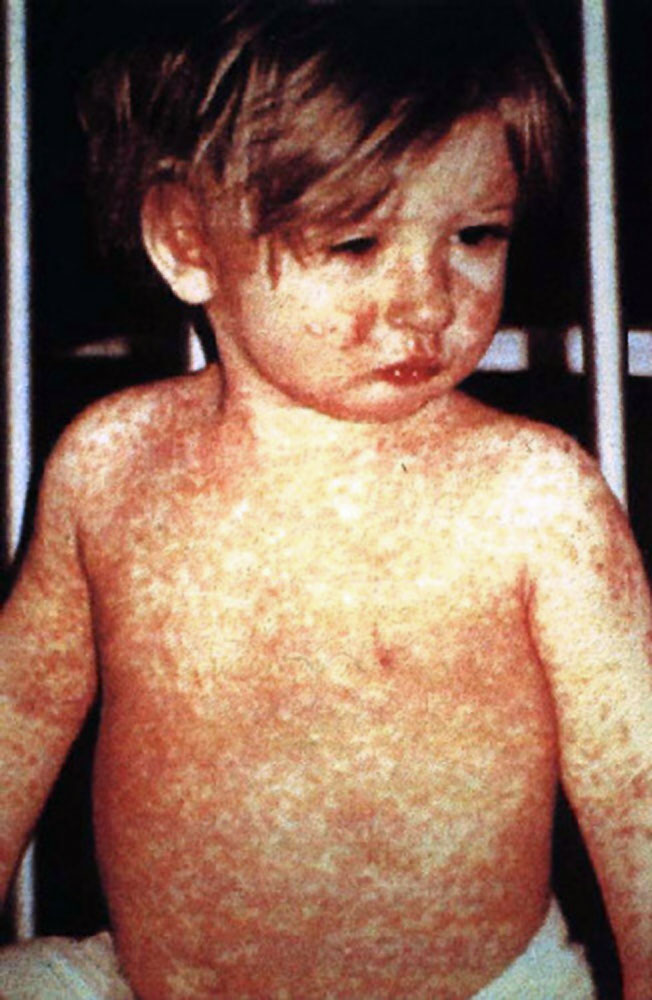
Ontario's dental regulator is direct about this. The Royal College of Dental Surgeons of Ontario told dentists in April 2025 that they must screen patients for measles signs and symptoms when confirming appointments and on arrival, and it lists Koplik spots among the things to look for (RCDSO). A suspected case has to be reported to the local public health unit immediately (RCDSO).
Read that as a referral job rather than a diagnosis. Nobody diagnoses measles from a dental chair, and I wouldn't try.
One honest caveat, because it cuts against this whole section. The spots aren't always there: Public Health Agency of Canada puts them at roughly 70% of cases, and notes their reliability has been questioned in recent years (PHAC). Two 2025 case series did worse than that. One found Koplik spots in 43% of 193 adults with measles (Infectious Diseases and Clinical Microbiology via PubMed), the other in 21 of 52 adults (Medical Journal Armed Forces India via PubMed).
No spots in your mouth doesn't mean no measles.
How much measles is actually around right now?
More than there was, and every number below comes with a date attached on purpose.
Public Health Agency of Canada's weekly monitoring report, last updated on 8 September 2026 with data through 29 August, counted 1,119 measles cases in Canada during 2026 across eight provinces (Public Health Agency of Canada). Ontario's own figure was 30 cases as of 18 August 2026 (Public Health Ontario).
Those two counts differ because they were taken on different days by different systems, not because one of them is wrong.
Figures like these move weekly. Check the date on any measles number you read, this post's included.
Is it far more likely to be something else?
Yes. Almost always, and here's what usually turns out to be sitting on a cheek instead.
Fordyce granules. Yellowish-beige bumps, one to three millimetres, on the inside of the cheek or lip, and common enough that the University of Toronto's dental faculty files them under variations of normal that need no treatment at all (University of Toronto Faculty of Dentistry). Three things separate them from Koplik spots: they're yellow-beige rather than white, there's no red base underneath, and they've been there for years rather than days.
Thrush. A yeast overgrowth that looks like white curd or cottage cheese on the cheek or tongue, and it scrapes off, leaving a red area behind (CDHO). Koplik spots don't wipe away.
Canker sores. Round or oval ulcers, no bigger than a few millimetres, ringed by a thin red halo, painful out of all proportion to their size, and few in number (Journal of the Canadian Dental Association). Koplik spots are flat, painless and numerous. Our guide to telling a canker sore from a cold sore works through that pair properly.
Hand, foot and mouth disease. Painful blisters that burst into ulcers covered by a yellow membrane, on the palate, tongue and cheek, alongside a rash on the palms and soles (CDHO). The pain is usually the complaint that brings someone in.
Linea alba. A plain white line running along the inside of the cheek at the level where your teeth meet, from ordinary friction (University of Toronto Faculty of Dentistry).
One white patch on that list behaves the opposite way. A thickened white patch that sits there for more than a couple of weeks, with no fever and no pain, is the one I want to see, because a small share of those can turn into something serious (Canadian Cancer Society). Persistence is the worrying feature there. With Koplik spots, it's the fever and the speed.
What should you do if you think it's measles?
Phone, don't walk in.
Call your doctor or your local public health unit and describe what you're seeing before you go anywhere. Public Health Ontario tells clinicians to report a suspected case without waiting for laboratory confirmation, so calling early isn't wasting anybody's time (Public Health Ontario).
Then stay home while you wait. Measles travels through the air better than almost anything else we deal with: more than 90% of susceptible people exposed to it catch it, and the virus can linger in the air of a room for up to two hours after the infectious person has left (Public Health Agency of Canada).
Someone with measles is infectious from four days before the rash appears until four days after it does (Public Health Agency of Canada). Count backwards and those four days before the rash are roughly when the mouth spots show up, which is exactly why this timing matters to anyone sitting in a waiting room.
This isn't a fussy illness, either. Ear infection and pneumonia each turn up in about 1 of every 10 cases, and inflammation of the brain in about 1 of every 1,000 reported cases (Public Health Agency of Canada).
Should you keep your dental appointment?
Not while you're ill. Move it, and tell us why you're moving it.
RCDSO requires Ontario dentists to screen patients for measles when appointments are confirmed and again on arrival, and to reschedule anyone who's ill (RCDSO). The College of Dental Hygienists of Ontario answers the same question flatly: postponing treatment is advised while a person is still contagious (CDHO).
Have no fear about making that call. Nobody in this office is irritated by a cancellation for illness, and a two-hour airborne window in a small treatment room is a genuinely good reason to move a cleaning to next month.
If you've got a real dental emergency and you're also unwell, call and say both things on the phone. Our emergency guide covers what actually counts as one.
Can a childhood fever leave marks on adult teeth?
It can, and measles is one of several illnesses linked to it. The honest version of this is weaker than the headline you may have seen.
A high fever during the years a child's teeth are still forming can leave permanent marks on the enamel, either pitting or white and brown patches. CDHO lists measles among the febrile illnesses that do this (CDHO).
In the research itself, though, measles sits inside a list of eight childhood illnesses, next to fever and antibiotic use, in a model with many contributing causes rather than one (European Archives of Paediatric Dentistry via PubMed).
So a bad fever in early childhood can show up later on the adult teeth. Nothing in the evidence says measles does something to enamel that another high fever wouldn't.
Worried about marks you've already got? Our post on fluoride in Toronto's water covers the white marks parents ask me about most, and most of those have nothing to do with any illness.
Frequently Asked Questions
Q: What do measles spots in the mouth look like? Small flat spots roughly two to three millimetres across, with a white or bluish-white centre on a red base, usually on the inside of the cheek opposite the back teeth (StatPearls via NCBI Bookshelf). They're called Koplik spots, they multiply fast and run together into patches, and they appear two or three days after the fever and cough start, before any rash (CDHO).
Q: Do Koplik spots always appear with measles? No, and that's important. Public Health Agency of Canada puts them at roughly 70% of cases and notes their reliability has been questioned in recent years (PHAC). One 2025 case series found them in 43% of 193 adults with measles (Infectious Diseases and Clinical Microbiology via PubMed). A clear mouth doesn't rule measles out.
Q: Can my dentist diagnose measles? No. A dentist can notice a sign and send you to the right place, which is a referral rather than a diagnosis. RCDSO requires Ontario dentists to consider measles when screening and to report a suspected case to the local public health unit immediately (RCDSO). Confirmation comes from public health and laboratory testing, never from a photograph or a dental chair.
Q: I've got white spots inside my cheek and no fever. Could it be measles? Almost certainly not. Koplik spots come with an acute illness: fever, cough, runny nose, red eyes. Painless white or yellow bumps in a well person are far more likely to be Fordyce granules, which the University of Toronto's dental faculty describes as a variation of normal requiring no treatment (University of Toronto Faculty of Dentistry). A white patch that thickens and stays for more than two weeks is a different matter and worth having looked at.
Q: Someone in my house has measles. Should I cancel my dental appointment? Call the office and say so, and expect to reschedule. RCDSO tells dentists to ask patients about contact with an infected person during an outbreak and to reschedule anyone who's ill (RCDSO). Your local public health unit will tell you how long to stay away based on your own immunity and the date you were exposed.
Q: Can measles damage my child's teeth? It can leave marks on enamel that was forming at the time, showing as pitting or white and brown patches, and CDHO names measles among the febrile illnesses that do this (CDHO). The research puts measles alongside seven other childhood illnesses and fever itself in a multi-cause picture (European Archives of Paediatric Dentistry via PubMed), so it isn't a measles-specific effect. If it's already happened, the marks are a cosmetic and decay-risk question we can look at.
Reviewed by Dr. Abinaash Kaur, B.Sc., DDS (University of Toronto Faculty of Dentistry), who has practised general and family dentistry in Bloor West Village for about 25 years. This article is general oral health information about a reportable communicable disease. It is not a diagnosis, not a substitute for examination, and not a substitute for advice from your physician or your local public health unit. Nothing here is guidance about immunization, which is a conversation for your family doctor.
Noticed something new on the inside of your cheek and you're otherwise well? That's worth a proper look, and it's the sort of thing we check at an ordinary visit. If you're unwell, phone us instead of coming in and we'll move your appointment without a fuss. We're at 750 Annette Street in Bloor West Village, serving the Junction, High Park, and Baby Point. Book a visit with The Village Dentist once you're feeling well and we'll have a proper look together.
